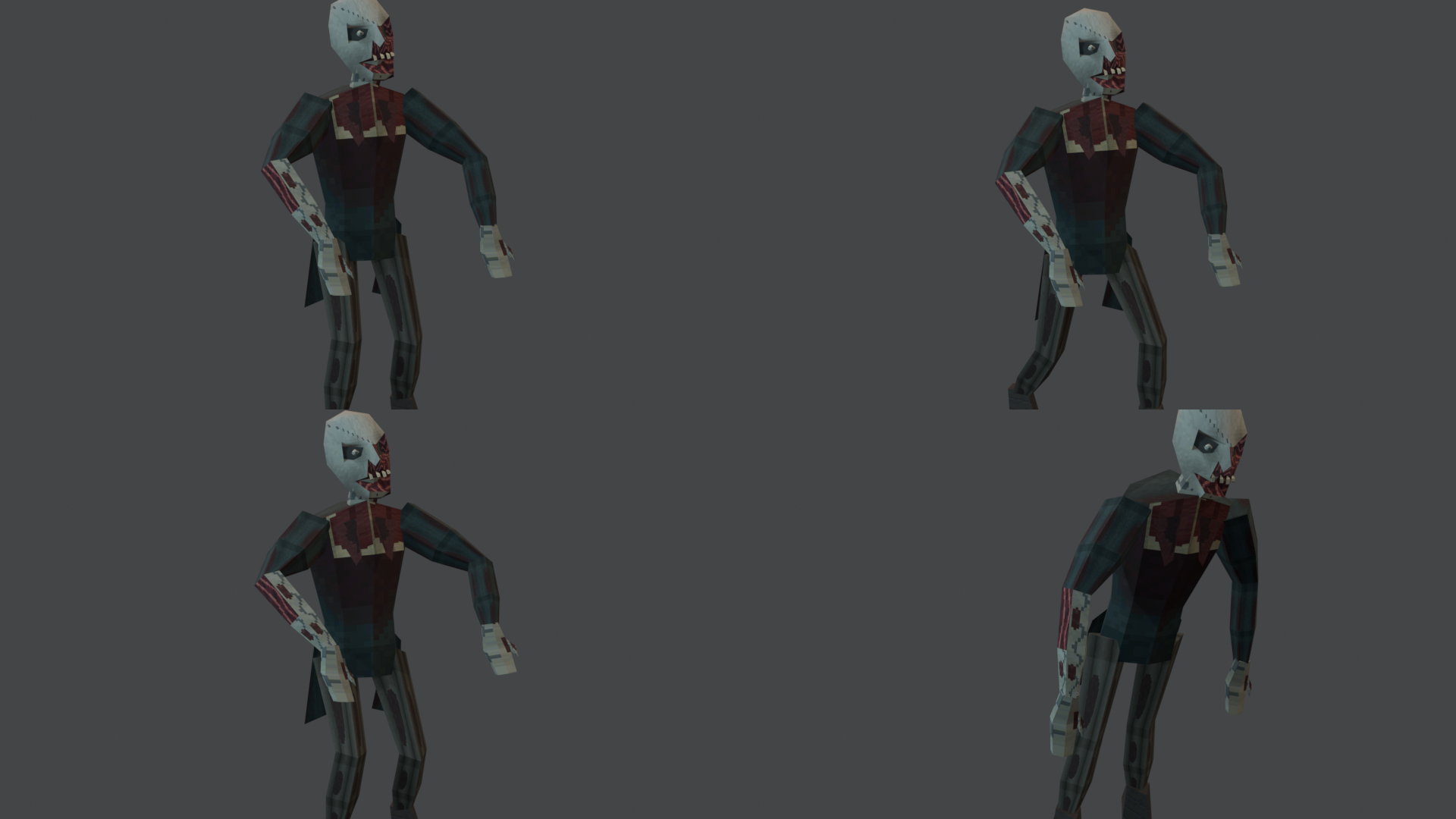
The Theatre Stalker had to be frightening in motion, not only in a clean Blender render. That changed how the zombie, weapon, and hands were built.
September 8 source update: the character has been rebuilt in Blender as a ruined formal usher, with narrow anatomy, uneven shoulders, a collapsed face and a ragged tailored coat. The nearby mesh has 500 triangles and retains the original 17-bone rig and four animation names. Its new textures place contrast around the face, lapels, wounds and hands. Separate static 120- and 24-triangle mid/far meshes share the same material language; the per-source ceilings remain 500, 120 and 24 triangles for near, mid and far. The source export report records these counts independently of runtime performance.
The original August rig used 433 triangles near, 80 mid and 13 far. Those counts describe the earlier art pass, not the September redesign. The pose system remains reusable while the geometry, UVs and textures can change.
Four states, four poses
Idle, walk, attack, and death are separate authored clips. Idle never becomes perfectly still: shoulders and head remain offset so the silhouette feels unstable. Walk drives the torso ahead of the hips. Attack compresses the body before extending both arms into the camera. Death breaks the vertical shape and clears the sightline.

Tiny3D stores the clips as separate animation streams. The build checks their embedded rom:/ paths because an earlier converter behavior could successfully emit a model whose animation path only made sense on the host machine. A zero exit code was not enough; the cartridge path became part of the asset receipt.
Build hands once
The starting viewmodel is an original five-inch Government-profile M1911 informed by public patent and manufacturer references. The September 8 redesign has 491 triangles including both posed hands. Its separately drawn slide, ejection port, trigger guard, grip panels, rear notch, and front blade retain real geometry, with newly authored worn steel and walnut textures.

The redesigned neutral hands are a separate editable 610-triangle model with a 35-bone rig. Named wrist, palm and finger chains support later grip poses without rebuilding the source geometry. This reusable source is budgeted separately from the posed runtime viewmodel; it does not add 610 triangles to the current first-person submission. The earlier August model had 456 triangles and 25 bones.
All nine asset source scenes are packed .blend files. Normal export reopens and reads those files without saving over edits. An explicit authoring command can reconstruct them and capture modeling milestones; it is separate from the ordinary asset build.
The sights dictated the first-person placement. Hip fire holds the pistol low enough to reveal the room. Aiming moves the rear notch, front post, and camera onto one optical centerline. Only after that alignment crosses its threshold does the synthetic reticle disappear. The browser and cartridge presentations implement the same visual contract independently.

Sound completes the motion
The 60-file bank uses an uploader-described real Colt 1911 exterior shot for its four short pistol cores. Four new original synthesized samples distinguish the shotgun, SMG, launcher and grenade explosion. Its theatre air, old projector, folding seats, metal door, and hall impacts are audited CC0 field recordings; the reload remains honestly labeled airsoft Foley. Two deterministic score layers carry the room tone and slowed projector under sparse modal tension instead of repeating one flat synthetic loop.
The audio director protects one weapon core, limits the whole mix to 12 sound effects, cools down zombie barks, steals only lower-priority voices, pans nearby actors, and ducks music around damage and round cues. Sustained fire can overlap two room tails, but it cannot stack several full gunshots into clipping.
Animation, sound, and gameplay remain event-driven. The simulation says that an attack landed or a round changed; each presentation decides how to move a rig, flash the HUD, and mix a cue. That division keeps the cartridge deterministic without making the horror presentation inert.